Hedging Language: When It Builds Credibility and When It Quietly Erodes It
By Oraton
•
3 Mins Read





Key Summary
A single word like may or will can completely change how readers judge your credibility. This article reveals why hedging builds trust in some contexts, but quietly erodes authority in others.
Researchers hedge to protect accuracy, while leaders, consultants, and executives are expected to provide clarity. The same sentence can sound rigorous in academia yet indecisive in a boardroom.
The difference between "suggests" and "demonstrates," or "might" and "will," isn't just grammar, it's a signal about confidence, evidence, and judgment. Used well, hedging calibrates certainty; overused, it dilutes influence.
The most persuasive communicators don't eliminate hedging: they use it deliberately. They match the strength of their language to the strength of their evidence, knowing exactly when to soften a claim and when to stand behind it.
A sentence that sounds careful in a research paper can sound hesitant in a business proposal. A claim that lands as confident in a client meeting can be read as overstated in an academic journal. The words are often the same. The context decides whether they signal rigor or uncertainty.
That's the terrain hedging language occupies. It's the set of words and phrases writers use to soften a claim, and how well a writer uses it says a lot about how well they understand their audience.
What hedging actually is
Hedging language makes a statement less direct or less absolute. Instead of saying something is true, a writer suggests it's likely, possible or generally the case. It shows up through modal verbs, qualifying adverbs, cautious phrases and reporting verbs, and it's a deliberate choice, not a grammatical slip.
Writers hedge for a handful of consistent reasons: to avoid overstating a claim the evidence doesn't fully support, to signal openness to other interpretations, to protect credibility when evidence is incomplete, to soften language that might otherwise invite pushback, and to meet the expectations of fields where cautious language is the norm, academic writing especially.
The common hedging toolkit
Category | Examples | What it does | Strong version → Hedged version |
Introductory verbs | suggest, appear, seem, indicate, tend | Attributes a claim to evidence instead of stating it as fact | "Research shows that X causes Y" becomes "Research suggests that X may cause Y" |
Modal verbs | may, might, could, can | Signals possibility instead of certainty | "This treatment reduces symptoms" becomes "This treatment may reduce symptoms" |
Hedging adverbs | possibly, probably, perhaps, generally | Qualifies likelihood or frequency | "Patients recover within a week" becomes "Patients generally recover within a week" |
Hedging adjectives | likely, possible, probable, uncertain | Marks a claim as tentative | "The outcome is effective" becomes "The outcome is likely to be effective" |
Hedging nouns | possibility, probability, tendency, assumption, evidence | Shifts focus from certainty to likelihood | "X causes Y" becomes "There is some evidence that X causes Y" |
Introductory phrases | it seems that, it appears that, according to, to our knowledge | Creates distance between writer and claim | "This policy reduces errors" becomes "It appears that this policy reduces errors" |
Quantifiers | some, many, several, a number of | Limits scope | "Employees resist change" becomes "A number of employees resist change" |
Conditional phrases | if true, if confirmed, if these findings hold | Frames a claim as dependent on something else | "This result will improve performance" becomes "If confirmed, this result could improve performance" |
A quick diagnostic: if a sentence sounds overly confident, try swapping in a hedge. If it sounds overly cautious, try swapping in a stronger verb. Watching how the tone shifts is often the fastest way to tell whether the current wording is doing its job.
When hedging is the right call
Hedging works when a writer needs to express real caution or avoid overstating what the evidence supports. In academic writing, it's often the difference between a hypothesis and an established fact. Consider the shift from "Children living in poverty do poorly in school" to "Children living in poverty tend to do poorly in school." The second version acknowledges variability instead of overgeneralizing. Or from "This treatment reduces symptoms" to "This treatment was associated with a 28% reduction in symptoms," which ties the claim directly to the strength of the underlying data.
Hedging can also function as politeness in certain cultural contexts, where indirect language signals respect or helps maintain social harmony rather than uncertainty about the facts.
When hedging works against you
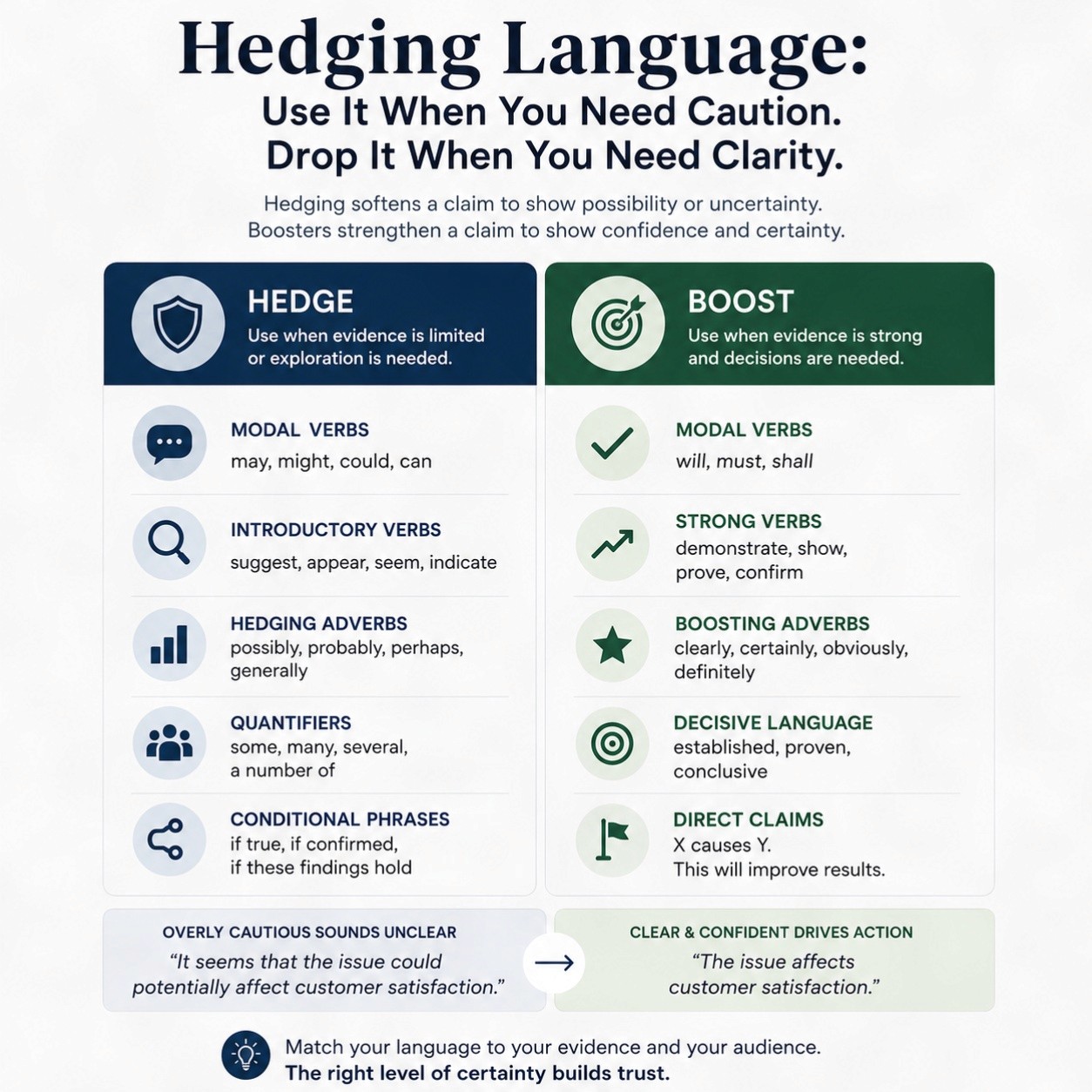
In professional writing, the calculus flips. When the goal is to inform a decision, recommend an action or demonstrate expertise, excess hedging undercuts the message. "We might consider updating the policy to improve efficiency" says less, and lands with less authority, than "Updating the policy will improve efficiency." "It seems that the issue could potentially affect customer satisfaction" buries a straightforward point under three layers of qualification when "The issue affects customer satisfaction" would do the job in half the words.
This matters especially when writing to patients, fiduciary clients, or any audience that may not read English as a first language. In those contexts, cautious language doesn't read as thoughtful. It reads as unclear, and unclear is its own kind of failure.
Your Weekly Leadership Communication
Edge
Every week, receive actionable insights on executive communication, leadership presence, stakeholder management, and difficult conversations—designed for ambitious professionals and leaders.
Join thousands of professionals sharpening their leadership voice.
The other lever: boosters
Boosters do the opposite of hedges. Words like will, clearly, certainly, demonstrate, show and prove strengthen a claim instead of softening it. They're useful when a writer has strong evidence and wants to guide a decision or prompt action, but they only work when the evidence backs them up. A booster used without solid support doesn't sound confident. It sounds exaggerated, and it costs the writer credibility fast.
Swapping "may" for "will" turns "This approach may improve efficiency" into "This approach will improve efficiency," a clear signal of decisiveness. Swapping "suggest" for "demonstrate" turns "The results suggest the policy could be effective" into "The results demonstrate that the policy is effective," a clear signal that the evidence itself is strong.
Putting it into practice
Good hedging is precise, not habitual. A few principles hold up across contexts:
Match the strength of the language to the strength of the evidence. Hedge where evidence is thin. Use stronger wording where it's solid.
Avoid stacking hedges. A sentence with three qualifiers in a row reads as unclear, not careful.
Be specific about what's actually uncertain, and hedge only that part of the claim.
Use hedging to narrow scope, not to blur meaning. There's a real difference between a phrase like "based on current data," which adds useful context, and a phrase like "it seems like," which usually just adds distance.
Think about what the audience expects. Some readers want caveats. Others want a clear recommendation.
Revisit hedging during revision, since the right level of certainty often only becomes clear once the full argument is on the page.
Stay consistent. Jumping between tentative and absolute language in the same piece confuses readers about where the writer actually stands.
None of this makes hedging inherently good or bad. It's a tool for calibrating certainty, and like most tools, its value depends entirely on whether it's being used on purpose.
At Oraton, we help leaders practice communicating with conviction when the evidence is clear, and nuance when it isn't.
Your Weekly Leadership Communication
Edge
Every week, receive actionable insights on executive communication, leadership presence, stakeholder management, and difficult conversations—designed for ambitious professionals and leaders.
Join thousands of professionals sharpening their leadership voice.
Previous

Executive presence isn't something leaders are born with. It's what repeated rehearsal, feedback, and preparation look like when the pressure is finally real.
Next

Employees rarely lose confidence because a leader makes difficult decisions. They lose confidence when they can no longer predict how that leader will respond under pressure.